From Cheese Vat to Ingredient Revenue: Mapping Whey Side-Stream Decisions
Whey is not one stream. It is a sequence of decisions.
For a dairy whey processor, the value of that side-stream is shaped before the first membrane pass: cheese make profile, solids load, mineral balance, fat carryover, microbial control, heat history, and the timing of conversion steps. The right enzyme program can help turn those variables into a more predictable ingredient route.
Seraflux works as an enzyme supplier for whey processing with a direct focus on plant fit: conversion targets, viscosity control, membrane behavior, throughput, flavor protection, and support from trial to scale-up.
Start with the whey you actually have
Sweet whey, acid whey, permeate, retentate, deproteinized whey, and mother liquor do not behave the same way. Treating them as a single raw material creates avoidable process noise.
Before selecting an enzyme route, define:
- Stream origin: rennet cheese, acid coagulation, Greek-style separation, ultrafiltration permeate, or crystallization side-stream.
- Composition window: lactose level, protein carryover, fat, minerals, solids, and ash.
- Heat exposure: pasteurization, concentration, evaporation, and holding steps.
- Downstream path: beverage base, syrup, powder, fermentation substrate, animal nutrition, lactose reduction, or specialty ingredient.
- Plant constraint: tank time, membrane load, evaporator capacity, dryer behavior, clean-in-place frequency, or sensory limits.
Enzyme selection should follow the route, not the catalogue.
The key decision: convert, separate, concentrate, or stabilize
Most whey processing decisions fall into four operating questions.
1. Do you need lactose conversion?
Lactose conversion can support low-lactose claims, improve sweetness balance, change crystallization behavior, and prepare a stream for fermentation or further ingredient use.
The practical buyer questions are:
- What conversion target is commercially necessary?
- Can the target be reached within available tank time?
- Will the stream be treated before or after concentration?
- Does conversion affect sweetness, browning risk, or powder behavior?
- How will the process be verified at plant scale?
A good enzyme program is not simply “more conversion.” It is the right conversion at the right point in the process.
2. Is viscosity limiting throughput?
As solids increase, viscosity can become a real operating limit. Higher viscosity affects pumping, heat transfer, membrane flux, evaporator load, and dryer feed consistency.
Seraflux helps processors evaluate where enzyme treatment may reduce viscosity pressure or improve handling without creating unwanted sensory or stability effects. The goal is controlled flow, not over-processing.
3. Are membranes becoming the bottleneck?
Membrane systems see every upstream inconsistency. Fat carryover, protein fines, mineral shifts, biofilm risk, and changing solids all show up as flux decline, pressure instability, or cleaning burden.
Enzyme treatment may be considered alongside clarification, separation, filtration strategy, temperature control, and sanitation design. The right question is not whether an enzyme can be added. The right question is whether it improves the membrane train’s operating window.
4. Will the ingredient taste clean?
Whey ingredients carry sensory risk. Uncontrolled reactions, excessive hold times, microbial drift, or poor enzyme fit can affect sweetness perception, cooked notes, bitterness, or downstream flavor masking.
For beverage, nutrition, and higher-value ingredient routes, sensory impact must be treated as a process parameter. Seraflux supports trial design that checks conversion and performance against flavor, color, and stability expectations.
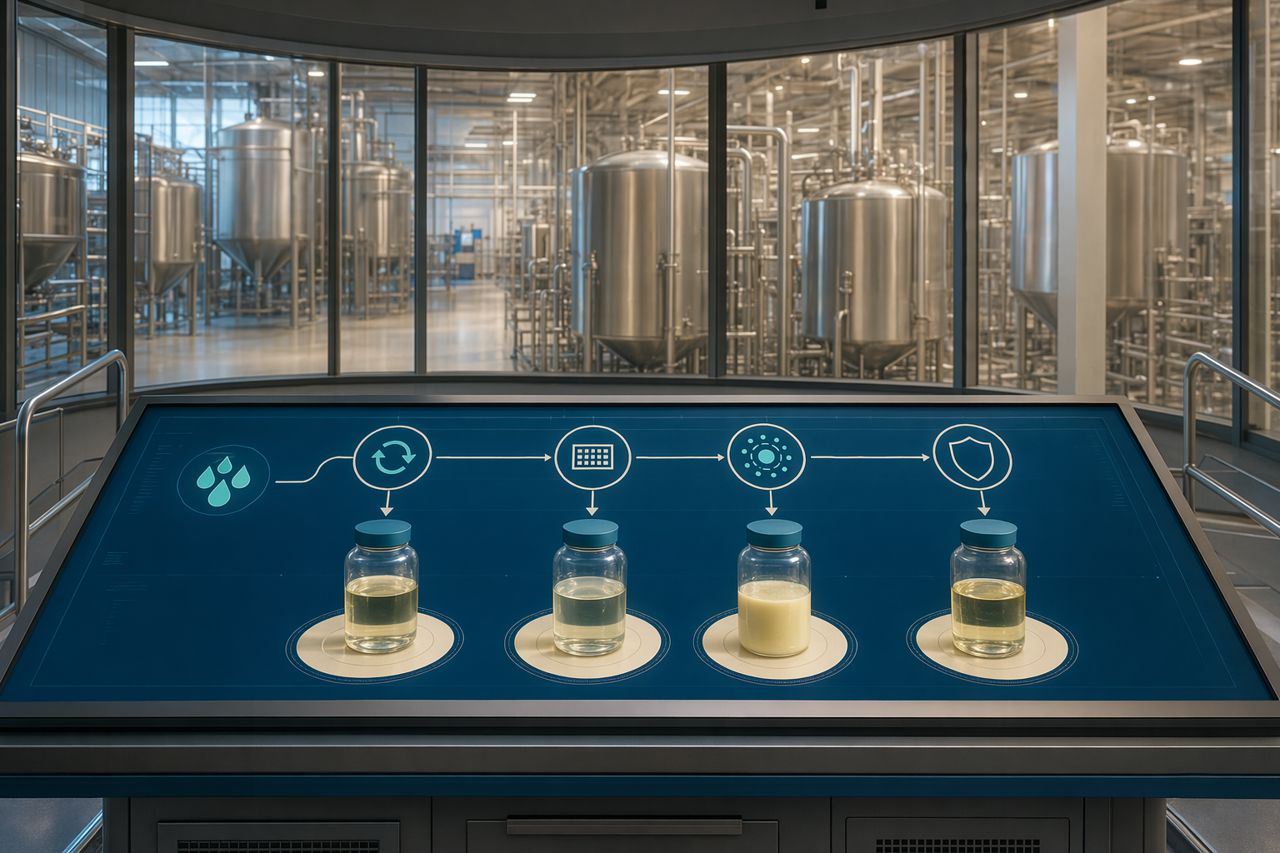
Where enzyme decisions sit in the whey map
At collection and balancing
This is where variability enters. Mixed streams, long holding, and changing cheese schedules can complicate downstream consistency. Enzyme planning should consider whether treatment happens batch-by-batch or after stream balancing.
Plant-ready question: Do you need flexibility for multiple whey sources, or is the stream consistent enough for a fixed treatment window?
Before concentration
Treating a lower-solids stream can improve mixing and heat transfer, but it may require more tank volume and longer hold capacity.
Plant-ready question: Is available residence time more valuable than treating a lower-viscosity stream?
After concentration
Treating after concentration may reduce volume and fit better with logistics, but higher solids can change mixing, reaction speed, and pumping behavior.
Plant-ready question: Can the enzyme perform reliably in the actual solids and viscosity range?
Before drying
For powder routes, conversion and ingredient behavior must be aligned with dryer performance, hygroscopicity, flowability, and storage stability.
Plant-ready question: Will the treatment improve product value without creating powder handling problems?
Before fermentation or ingredient blending
For fermentation substrates and blended ingredients, enzyme treatment can help prepare a more usable sugar profile or functional base.
Plant-ready question: What substrate profile does the next process actually need?
What Seraflux brings to whey processors
Seraflux is built for industrial enzyme decisions where production reality matters.
We support:
- Enzyme selection based on stream type and commercial target.
- Process placement guidance across tanks, membrane systems, evaporators, and drying lines.
- Trial planning for conversion, viscosity, sensory, and throughput outcomes.
- Scale-up support that accounts for mixing, hold time, temperature, and sanitation routines.
- Supply continuity for processors moving from test work to routine production.
- Documentation support for purchasing, technical review, and operational handover.
The aim is simple: make the enzyme step easier to justify, easier to run, and easier to repeat.
A practical evaluation path
Step 1: Define the revenue route
Start with the intended ingredient value: lactose-reduced base, sweetened whey ingredient, fermentation feed, powder, syrup, or blended dairy ingredient. The revenue route sets the conversion and quality targets.
Step 2: Capture the operating window
Map pH, temperature, solids, holding time, mixing, heat history, and downstream constraints. These conditions determine whether a proposed enzyme step is realistic.
Step 3: Run a controlled plant-relevant trial
Trial design should reflect the stream as processed, not an idealized lab sample. Track conversion progress, viscosity behavior, sensory impact, membrane response, and downstream handling.
Step 4: Confirm scale-up economics
A technically successful enzyme step still needs to fit production cost, tank scheduling, labor, cleaning, and supply planning. The best solution is one operators can run without special handling complexity.
Buyer checklist: before you request a specification
Bring these details to the discussion:
- Whey type and source cheese process.
- Typical solids and variability.
- Current bottleneck: conversion, viscosity, membranes, evaporation, drying, flavor, or yield.
- Target ingredient route and customer requirement.
- Preferred treatment point in the process.
- Available residence time and temperature range.
- Current cleaning and sanitation constraints.
- Packaging, storage, and distribution format for the final ingredient.
Better inputs lead to a more accurate recommendation.
The value is in controlled flow
Whey processing rewards control. Not dramatic intervention. Not generic enzyme addition. Control.
When conversion targets, viscosity, membranes, sensory expectations, and plant scheduling line up, a side-stream becomes an ingredient platform. Seraflux helps processors make that map practical.
Request a quote
If you are evaluating an enzyme step for whey conversion, viscosity control, membrane support, or ingredient development, send us your process window and target outcome.
Request a quote using the on-site form
A Seraflux technical contact will review the application and respond with a practical supply and support path.